Unconditional Surrender - But Whose?
Washington wants to manage the crisis; Tehran is playing to win

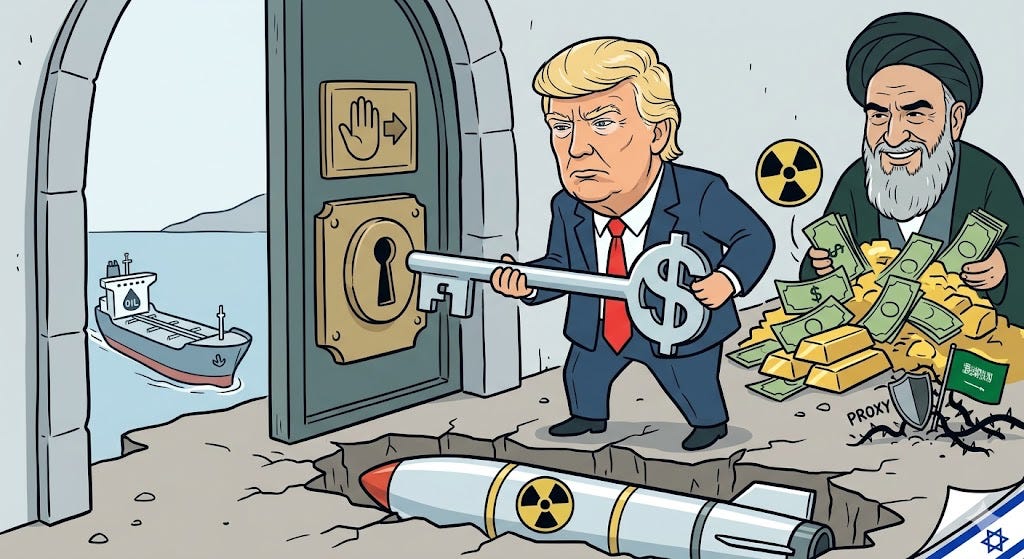
(Originally published in B'Sheva)
Reports suggest that the talks between the United States and Iran are not converging toward a grand, comprehensive bargain, but rather a temporary interim agreement. This short-term framework is designed to halt the ongoing escalation, reopen the Strait of Hormuz, and grant Iran limited relief on its oil exports, all while pushing deep, foundational questions, particularly the nuclear issue, further down the road. This is all unfolding just weeks before the World Cup is set to kick off, and with the US midterm elections looming on the horizon. In other words, Washington and Tehran are not necessarily close to resolving the crisis, they are simply trying to manage it.
According to some of the published details, the emerging understandings begin with Iran's immediate demands: a broad ceasefire that includes secondary fronts like Lebanon, a gradual reopening of the Strait of Hormuz, temporary sanctions relief on oil, and future discussions regarding the release of frozen assets and broader sanctions removal. In this context, it remains unclear what the US, and by extension Israel, receives in return. Discussions on Iranian concessions regarding its nuclear program, most notably the fate of its enriched uranium, have essentially been deferred to the next stage. Even when American officials speak of a tentative Iranian commitment on the matter, Tehran makes sure to publicly deny any actual concessions.
If these reports are accurate, this represents a significant achievement for the Islamic Republic. The regime entered these talks under intense military, economic, and infrastructural pressure. Yet, it managed to leverage the Strait of Hormuz, the global energy market, and both regional and American public opinion to pressure Washington, while it remains unclear what the US gains in return. Instead of negotiations beginning with how to dismantle or export Iran's stockpile of enriched uranium, they are starting with how to prevent another spike in energy prices. This is precisely the playground where Iran excels at bargaining: it manufactures a systemic risk, and then sells the reduction of that risk as a diplomatic achievement.
The Hormuz issue is far from purely technical. Iran is not interested merely in opening the strait, it wants to secure a special status there, ensuring the situation does not simply return to the pre-crisis status quo. Tehran recently went so far as to announce the establishment of a "Strait of Hormuz Protection Authority," effectively marking its territory and extending its control all the way to the Port of Fujairah on the eastern coast of the United Arab Emirates. If the agreement leaves Iran with the capability to block, threaten, or exact a political price on maritime traffic, it will not solve the problem but rather institutionalize it. From Tehran's perspective, the mere fact that the West is forced to negotiate the rules of the game in Hormuz is a strategic victory.
Regional and Domestic Pressures
The role of the Gulf states in these events raises several question marks. Former President Trump noted last week that a date had already been set for an American military strike, but regional leaders asked him to cancel the plans and give diplomacy a chance. This claim, which has since been denied by various countries, is particularly interesting given the lack of cohesion the Gulf states have shown so far regarding Iran. There is a stark contrast between the hawkish stance of the UAE, which took significant fire and demanded a reality free of Iranian ballistic or naval threats (and reportedly even carried out strikes inside Iran), and Saudi Arabia, which has favored dialogue initiatives. It is highly possible that a shared weariness of war brought these leaders closer together, leading to collective regional pressure on Trump to hold back on a strike.
Simultaneously, a carefully engineered narrative is taking root in both the American and regional media. This narrative suggests that Israel dragged the US into a purposeless, unwinnable war. Reports have also claimed that the US "wasted" many of its interceptors defending Israel, leading to delays in American defense industry deliveries to other nations. This anti-Israel, and at times antisemitic, pressure is weighing heavily on Trump, and it may well influence his calculations moving forward.
In this regard, Trump's intriguing recent tweets are worth noting. He claimed to have demanded that a surprised Saudi Arabia, Qatar, and Pakistan, and perhaps even Iran itself, join the Abraham Accords with Israel. However, this may simply be his way of pushing back against their leverage and creating domestic political pressure within those countries.
Regardless, Washington’s sense of urgency stems from more than just regional dynamics. The Trump administration is operating under mounting domestic pressure: high energy prices, fears of renewed inflation, the upcoming World Cup, eroding public trust, and rising political criticism ahead of the midterms, including from within the Republican base itself. It is also possible that the resignation, or firing, of Director of National Intelligence Tulsi Gabbard a few days ago stemmed from a lack of confidence in Trump’s decision-making regarding Iran.
Consequently, for the White House, a "reasonable" deal that lowers the flames may be preferable to continuing an expensive, unpredictable, and politically dangerous campaign. Reports of falling oil prices driven by optimism surrounding the talks illustrate just how heavily the economic arena weighs on American decision-making. At the same time, it is worth noting that Trump continues to post threatening tweets aimed at Iran, keeping the military option visibly on the table.
What Lies Ahead for Israel?
For Israel, the implications of this shift are twofold.
First, it must guard against an interim agreement that provides Iran and its proxies with economic oxygen, diplomatic legitimacy, and time, without establishing a real mechanism to halt the nuclear program, the missile project, and the proxy network. Second, Israel must ensure that the American desire for quiet does not translate into restrictions on Israeli freedom of action against Iranian violations or its proxies, especially in Lebanon. A ceasefire that fails to restrain Hezbollah could easily become a rehabilitation mechanism for the Axis rather than a secure, lasting arrangement.
On the nuclear front, while there is immense focus on the 400 kilograms of 60% enriched uranium in Iran's possession, which was apparently buried during the American bombings last June, another critical point must be emphasized. Iran also holds hundreds of additional kilograms of uranium enriched to lower levels of 20%. This level is already vastly higher than what is required for civilian nuclear energy, which is roughly 5%.
This means that any hollow Iranian declaration about having no desire to develop a nuclear weapon cannot be taken at face value. Israel must continuously emphasize the existence of these specific stockpiles to the United States.
Ultimately, this strategic event is not in Israeli hands; it will be finalized between the Trump administration and Iranian representatives. Nonetheless, Israel must engage with Washington immediately, working both with the administration and with allies in the House and Senate before this interim framework solidifies into a permanent reality.
The red lines must be clear:
The removal of all enriched uranium from Iran or its irreversible neutralization.
Strict oversight of all nuclear facilities.
A total ban on rehabilitating sensitive nuclear and ballistic missile infrastructure.
An automatic "snapback" response mechanism for any violations.
The preservation of Israel’s freedom of action against both Iran and Hezbollah.
If the agreement begins with Hormuz and ends with a mere promise to discuss the nuclear issue in the future, it will be a temporary pause that allows for rearmament rather than a real solution. Israel may not be able to stop the diplomatic momentum, but it must ensure that diplomacy does not become a bypass route around a decisive outcome, at the direct expense of its national security.